I Used to Walk Onstage to Be Liked. Here's What Happened When I Finally Quit.
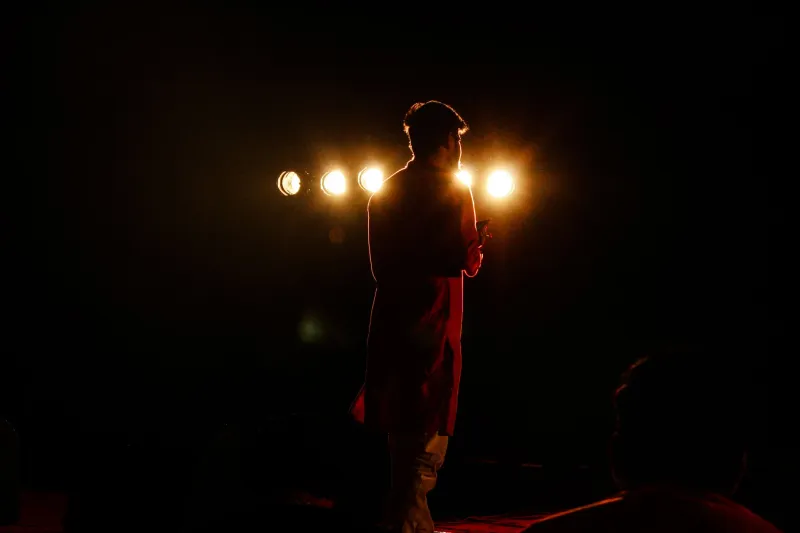
There's a version of me that used to spend the twenty minutes before a show mentally rehearsing how to be charming. Not how to be present. Not how to be honest. Charming. Like if I could just hit the right notes of warmth and wit and self-deprecating humor, the audience would leave happy, and I'd feel like I'd done something real.
Spoiler: they left happy. I did not feel like I'd done something real.
It took me an embarrassingly long time to name what was actually happening. I wasn't performing for people. I was performing at them — running a kind of invisible approval loop where every laugh, every round of applause, every compliment at the merch table was data I was feeding back into the machine. The goal wasn't connection. The goal was a clean, high score.
And the wild thing? I was pretty good at it. Which made it so much harder to quit.
The Difference Nobody Talks About
Entertaining and connecting are not the same thing, and I think a lot of us in this industry blur that line on purpose because the distinction is uncomfortable.
Entertaining is a transaction. You bring the energy, the craft, the spectacle — and the audience gives you their attention and approval in return. It's not nothing. It's actually a real skill, and there's genuine value in it. But it has a ceiling. Because at the end of the night, the entertainer goes home, and the audience goes home, and nobody's life has actually shifted.
Connection is something else entirely. Connection requires you to show up as a specific person — not a polished, universally palatable version of yourself, but the actual you, with your actual stakes and your actual weird relationship to the material you're performing. Connection asks something of you that likability never does: it asks you to stop managing how you're perceived and just be perceivable.
The paradox I kept bumping into was this — the more I tried to make everyone like me, the less anyone could actually see me. And if they couldn't see me, what exactly were they connecting to?
The Night It Cracked Open
I remember the specific show where something shifted. It wasn't a triumphant moment. It was actually kind of a disaster, at least by the metrics I'd been using.
I was mid-performance when something I said landed wrong — not offensive, just genuinely awkward. One of those moments where you can feel the air in the room change. Old me would have immediately pivoted, cracked a joke, smoothed it over, done whatever it took to get everyone back on my side.
Instead, for reasons I still can't fully explain, I just... stayed in it. I acknowledged the weirdness. I said something honest about why I'd gone there, even though the honest answer made me look uncertain and a little raw. I didn't try to fix the mood. I just let the moment be what it was.
And something happened in that room that I hadn't felt in years. People leaned in. Not because I was winning them back — but because they could suddenly tell they were watching a real person navigate something real. The applause at the end of that show felt completely different. Less like a grade. More like a conversation.
Why Likability Is Actually a Trap
Here's the thing about optimizing for likability: it requires you to constantly anticipate what other people want from you and then deliver it. Which means you're never actually leading. You're always following the room, just slightly ahead of it.
And audiences? They feel that. Maybe not consciously, but on some gut level, people know when they're being managed. They know when the performer in front of them is more focused on their own approval rating than on the actual moment happening between them. It creates this subtle but persistent sense of distance — like watching someone through glass.
Vulnerability closes that gap. Not performed vulnerability, not the kind where you do a careful little confessional that you've workshopped for maximum relatability. Real vulnerability, which is messier and less strategic and involves genuine uncertainty about how it's going to land.
The audiences who have meant the most to me — the ones who've followed my work, who show up again and again, who reach out after a show with something that actually moves me — they didn't find me because I was likable. They found me because at some point I stopped trying to be, and they recognized something in that.
What I Actually Do Now
I won't pretend I've got this all figured out. There are still nights when I catch myself slipping back into approval mode, especially when I'm tired or anxious or when the stakes feel high. The pull toward likability is strong, and it's sneaky.
But I've built some habits that help. Before I walk out, I ask myself one question: What do I actually want to say tonight? Not what will land well. Not what the crowd seems to want. What do I, Ruthie Sommers, want to say — and do I believe it enough to say it even if it doesn't get the response I'm hoping for?
Most nights, that question does something useful. It reorients me toward the work instead of toward the reaction to the work. It reminds me that my job isn't to be liked. My job is to show up fully and let the people in the room decide what to do with that.
Sometimes they love it. Sometimes they don't quite know what to make of it. Occasionally someone walks out, and that used to wreck me, and now I understand it differently — if someone's leaving because they wanted something more comfortable, that means I was doing something honest.
The Audience You Actually Want
When you stop performing for everyone, you start performing for someone. And that specificity — that willingness to be a particular kind of artist who is not for everyone — is exactly what builds the kind of audience that actually sustains a career.
I'd rather have five hundred people who feel genuinely seen by something I did than five thousand people who thought I was pleasant and forgot about me by the time they hit the parking lot.
Likability is wide and shallow. Connection is narrow and deep. And deep is where the real stuff lives — the stories that stay with people, the performances that get talked about years later, the work that actually means something.
I spent a long time being pretty likable. I'm a lot more interested now in being real.