When the Applause Becomes the Whole Point — And Why That's a Problem
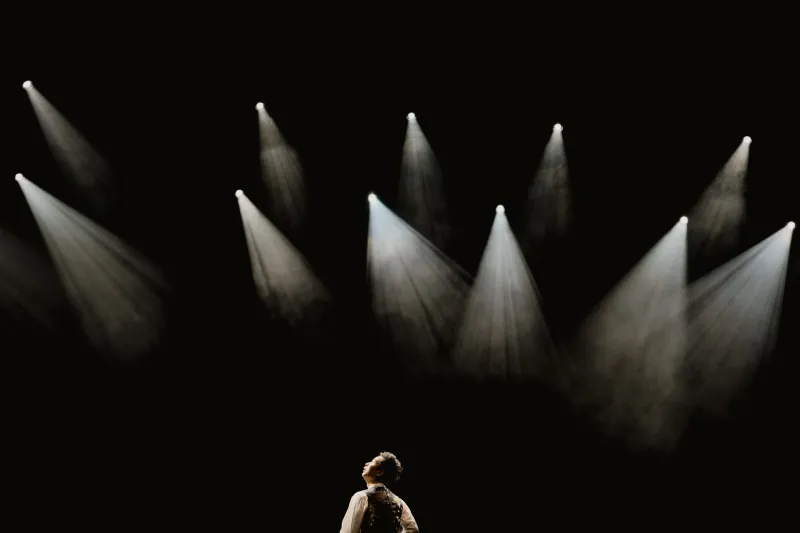
The Night I Realized I Was Performing for the Wrong Audience
I remember a specific performance — one I won't name because it doesn't matter — where I walked offstage feeling completely hollow. The applause was loud. People came up afterward with kind words. By every external measure, it had gone well.
And I felt nothing. Worse than nothing. I felt like I'd been running a con.
It took me a long time to understand what had actually happened that night. I hadn't been telling a story. I'd been managing impressions. Every choice I made onstage that evening had been quietly filtered through a single question: Will they like this? Not: Is this true? Not: Does this serve the work? Just — will they approve?
That's a subtle distinction, but it changes everything about what ends up happening on that stage.
Approval-Seeking Wears Really Good Costumes
Here's the tricky part: performing for approval doesn't always look like insecurity. Sometimes it looks like professionalism. Sometimes it looks like preparation. Sometimes it genuinely looks like dedication to craft.
You show up early. You know every note, every beat, every line. You've watched footage of yourself and corrected your posture and your diction. You've done the work. And yet underneath all that diligence, there's a quiet, anxious engine running — the one that's calculating audience response in real time and adjusting accordingly.
Perfectionism is probably the sneakiest form of this. We dress it up as high standards, but a lot of the time it's really just a preemptive defense against criticism. If I make it flawless, no one can say anything bad about it. If I sand down every rough edge, I'm safe.
The problem is that rough edges are frequently where the truth lives.
People-pleasing does the same thing in a slightly different outfit. It shows up as flexibility — I can adjust my style to whatever this director wants, whatever this audience expects — but what it's actually doing is quietly erasing your perspective from the work entirely. You become a mirror instead of a window. And mirrors, however shiny, don't have anything to say.
What Performing From Truth Actually Feels Like
I want to be careful here, because I think there's a romanticized version of "authentic performance" that's its own kind of trap. It doesn't mean ignoring your audience, blowing off preparation, or treating every instinct like sacred wisdom. That's not authenticity — that's just ego wearing a linen shirt.
Performing from truth is quieter than that. It feels less like liberation and more like... steadiness. Like you have a center of gravity that isn't located in the room's reaction to you.
For me, it usually shows up in small moments. There's a specific quality of attention that comes when I'm genuinely inside the work — not watching myself do the work, but actually doing it. The audience exists, but they're not the judge. They're more like... fellow travelers. I'm taking them somewhere, not auditioning for their approval to lead.
The performances I'm most proud of? Almost none of them felt safe while I was doing them. They felt exposed. Risky. Like I was handing something over that I actually cared about, which meant it could actually be rejected. That's a terrifying feeling. But it's also the only version of this job that makes me feel like I'm doing something real.
Practical Ways to Recalibrate When You've Drifted
So what do you do when you notice you've slid into performance-as-transaction? When you've been chasing the approval so long you can't quite remember what you were originally trying to say?
Go back to the thing that made you want to do this in the first place. Not the career. Not the goals. The actual original impulse. For a lot of us, there was a moment — a show we saw, a song that cracked us open, a role we played in a school production that made us feel, for the first time, completely alive. Return to that. Not to recreate it, but to remember what it felt like to create without a calculated outcome.
Ask different questions during your preparation. Instead of how will this land? try what is this actually about? Instead of will they understand this choice? ask do I understand this choice? It sounds simple, but the questions you ask yourself during rehearsal shape the entire internal architecture of a performance.
Create something with no audience. Seriously. Write a song no one will hear, work on a monologue you'll never perform, dance in your kitchen. The goal is to practice making something when approval is structurally off the table. It retrains your creative instincts to operate without the approval engine running.
Notice the physical difference. Approval-seeking often has a physical signature — a kind of bracing, a tightness in the chest, a tendency to watch yourself from the outside. Performing from truth tends to feel more like release. Learn to recognize those sensations in your own body, because your nervous system usually knows before your brain does which mode you're operating in.
The Audience Deserves the Real Version
Here's something I've come to believe pretty firmly: when we perform for approval, we're actually being a little condescending to our audience. We're assuming they can't handle the real thing. We're giving them a pre-digested, smoothed-out version of the work because we don't trust them — or ourselves — enough to offer the genuine article.
But people are remarkably good at sensing truth. They might not be able to articulate what's different about a performance that's coming from an honest place, but they feel it. It's the difference between watching someone and being with someone. One experience passes through you; the other stays.
The applause, when it comes after something real, sounds different too. Or maybe it doesn't sound different — maybe it just lands differently inside you. Because you know what you actually gave, and you know they received it.
That hollow feeling I described from that performance years ago? I haven't felt it in a while. Not because the work has gotten easier or the stakes have gotten lower. But because I've gotten better at checking in with myself before I walk out there — asking not are they going to love this? but is this actually true?
It's a small shift. It changes everything.